Gold standard, redefined.
Leveraging K-One, Kimialys’ proprietary surface chemistry, we develop, manufacture, and supply high-performance gold bioconjugates optimized for your biomolecules and applications. Since 2020, we support pharmaceutical and diagnostic companies, as well as CROs and CDMOs, across a broad range of applications, from point-of-care testing and molecular diagnostics to analytical characterization, immunogenicity testing, and biomolecule extraction for concentration and depletion.
Sensitivity alone is only half the story.
Depending on the application, conventional gold, magnetic, latex, or luminescent nanoparticles can be very effective. But when target biomarkers are present at very low concentrations, detecting them reliably becomes much more difficult. Some systems fail to achieve the required sensitivity. Others can, but only at the cost of excessive non-specific interactions that make the results unreliable and difficult to exploit.
Where Kimialys’ bioconjugates make a difference.
K-One gold bioconjugates are not designed to replicate the automation power of magnetic beads or the extreme sensitivity of luminescent particles. Their value lies in the balance between performance, reliability, and cost-effectiveness:


Optimal selectivity
Significantly reduce non-specific binding (NSB) to ensure clean and reliable results.

Reliable in complex samples
Achieve consistent and reproducible results in complex samples, including plasma, saliva, urine, and milk.

Cost-effective bioconjugation
Reduce ligand consumption on nanoparticles by up to 30x, significantly lowering assay costs.

High-sensitivity gold bioconjugates
Achieve up to 10x higher sensitivity than conventional gold bioconjugates.

Controlled quality process
We ensure batch-to-batch consistency, from bare gold nanoparticle manufacturing to K-One pre-functionalization and bioconjugation.

Compatible with capture systems
Keep the benefits of K-One while working with standard capture systems such as streptavidin, protein A/G, anti-Fc, and anti-Fab.
Biodetection

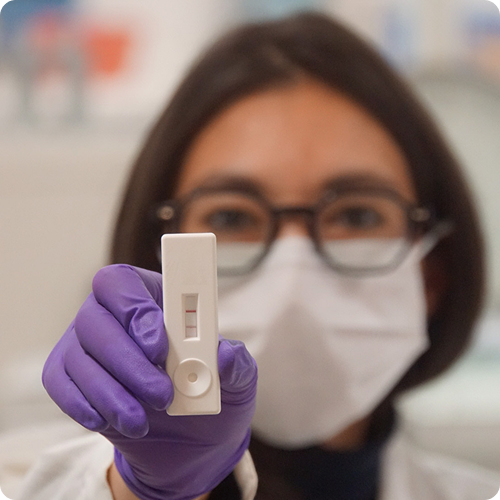
Lateral Flow Assays (LFAs)
Colorimetric assays
Nanoparticle-based signal enhancement
Biomolecule extraction
DNA/RNA extraction for amplification
Immunogenicity testing (e.g., ADA depletion)
Immunoprecipitation (e.g., IP–MS, ADC–DAR)

Gold nanoparticles are widely used as bioconjugates, often prepared by passive adsorption for LFAs and other colorimetric assays, and valued for their ease of use and strong optical response in the visible range.
Magnetic beads are widely used for targeted capture and extraction, thanks to their ease of use and compatibility with automated platforms.
Latex beads are widely used in turbidimetry and nephelometry, valued for their ease of use and strong light-scattering properties. They are also available in multiple colors for multiplex LFA applications, as well as in fluorescent variants that can deliver higher sensitivity.
Luminescent nanoparticles, such as quantum dots (QDs) and upconversion nanoparticles (UCNPs), are newer classes of optical reporters. More expensive than conventional alternatives, they are valued for their high sensitivity and narrow emission spectra, which support advanced multiplexing.

K-One gold nanoparticles are designed for challenging assays where targets are present at very low concentrations in complex matrices, and where high sensitivity must be achieved without increasing non-specific binding or compromising reproducibility. This is where Kimialys’ bioconjugates make a difference.
| Criteria | Standard gold NPs | Magnetic | Latex (colori) | Latex (fluo) | Luminescent (QDs, UCNPs) | K-one gold NPs |
|---|---|---|---|---|---|---|
| Analytical sensitivity |
 |
|
|
|
|
 |
| Selectivity (no NSB) |
|
|
|
|
|
|
| Cost savings |
|
|
|
|
|
|
| Automation compatibility |
|
|
|
|
|
|
| Multiplex color capability |

- |
- |
 |
|
|
- |
Table: Performance comparison of K-One gold nanoparticles with conventional nanoparticles and beads.


You’ll first connect with our scientific sales team to discuss your needs and project goals.
You’ll meet our technical team to dive deep into your application and challenges. Based on these discussions, we build a detailed work plan and list all required materials, including your biomolecules (ligand(s), secondary antibody(ies), target(s), and media (buffers or biological fluids)). It is important that we can work as close as we can from your application's final conditions, whatever the assay format.
Once we agree on scope, timing, and cost, we move straight to practical implementation.
Let’s Kick Things Off!
One week before work begins, we hold a comprehensive kick-off meeting where all details are finalized and final questions are answered. This is the moment to meet the person in charge of the project at Kimialys, who will be your contact throughout the entire project.
From there, you stay connected with our scientists at every step, keeping you fully informed on progress.
We deliver a comprehensive presentation and report on the bioconjugate optimization process and results. Based on our initial agreement, you receive your optimized bioconjugates with buffers and detailed protocols.
Curious about how our K-One gold bioconjugates can bind with your current needs?

Lorem ipsum dolor sit amet, consectetur adipiscing elit. Suspendisse varius enim in eros elementum tristique.

Pre-functionalization of SPR sensor chips using K-One® surface chemistry, specifically customized to your applications
Optimal ligand immobilization following Kimialys' proprietary protocol
In-house biomolecular interaction analysis with our own SPRi/SPR platforms
Reliable access to binding and kinetics data, complemented by high-quality reports and presentations, offering actionable insights
We harness both our expertise in SPRi and proprietary K-One® technology on chip to swiftly identify and rank both desired and undesired binding interactions among numerous candidates. This ensures our customers receive consistent and reliable results, accelerating their pursuit of new therapeutics.
We can immobilize any ligands:
Antibodies
Nanobodies
Small molecules
Proteins
DNA/RNA
Whole cells
Peptides
Aptamers
And more...
Our results are consistent and reliable for any complex biological matrices:
Plasma
Serum
Blood
Stem cell supernatant
Hybridoma supernatant
And more...
Reliable measurement of kinetic constants is pivotal for the development of new therapeutics. Leveraging our proprietary K-One® technology, we stand out in the SPR landscape by delivering precise characterization analysis for all biologics and compounds.
Kinetics measured:
Affinity (KD)
Binding rate constants (kon, koff)
Avidity
Pre-functionalization of SPR sensor chips using K-One® surface chemistry, specifically customized to your applications
Optimal ligand immobilization following Kimialys' proprietary protocol
In-house biomolecular interaction analysis with our own SPRi/SPR platforms
Reliable access to binding and kinetics data, complemented by high-quality reports and presentations, offering actionable insights
We harness both our expertise in SPRi and proprietary K-One® technology on chip to swiftly identify and rank both desired and undesired binding interactions among numerous candidates. This ensures our customers receive consistent and reliable results, accelerating their pursuit of new therapeutics.
We can immobilize any ligands:
Antibodies
Nanobodies
Small molecules
Proteins
DNA/RNA
Whole cells
Peptides
Aptamers
And more...
Our results are consistent and reliable for any complex biological matrices:
Plasma
Serum
Blood
Stem cell supernatant
Hybridoma supernatant
And more...
Reliable measurement of kinetic constants is pivotal for the development of new therapeutics. Leveraging our proprietary K-One® technology, we stand out in the SPR landscape by delivering precise characterization analysis for all biologics and compounds.
Kinetics measured:
Affinity (KD)
Binding rate constants (kon, koff)
Avidity
Pre-functionalization of SPR sensor chips using K-One® surface chemistry, specifically customized to your applications
Optimal ligand immobilization following Kimialys' proprietary protocol
In-house biomolecular interaction analysis with our own SPRi/SPR platforms
Reliable access to binding and kinetics data, complemented by high-quality reports and presentations, offering actionable insights
We harness both our expertise in SPRi and proprietary K-One® technology on chip to swiftly identify and rank both desired and undesired binding interactions among numerous candidates. This ensures our customers receive consistent and reliable results, accelerating their pursuit of new therapeutics.
We can immobilize any ligands:
Antibodies
Nanobodies
Small molecules
Proteins
DNA/RNA
Whole cells
Peptides
Aptamers
And more...
Our results are consistent and reliable for any complex biological matrices:
Plasma
Serum
Blood
Stem cell supernatant
Hybridoma supernatant
And more...
Reliable measurement of kinetic constants is pivotal for the development of new therapeutics. Leveraging our proprietary K-One® technology, we stand out in the SPR landscape by delivering precise characterization analysis for all biologics and compounds.
Kinetics measured:
Affinity (KD)
Binding rate constants (kon, koff)
Avidity
Pre-functionalization of sensor chips using K-One® surface chemistry, specifically customized to your applications and analytical platforms
Supply of batches of pre-functionalized sensor chips + ligand immobilization protocol and reagent
For companies looking to manage their own analyses, yet eager to leverage our expertise in chip functionalization and our proficiency in tackling complex analytical challenges.
We provide custom pre-functionalized sensor chips, specifically designed for your ligands, analytical platform, and applications, ensuring that your analyses run smoothly and effectively.
Gold-based sensor types:
For common SPR and SPRi platforms: Biacore, Horiba...
Other SPR-based biosensors: LSPR, Fiber Optic SPR, LR-SPR...
For chip-based diagnostic applications: electrochemical biosensors, QCM...
Our K-One® surface chemistry technology is available for licensing, offering the opportunity to integrate it within your own production environment and standards.
Lorem ipsum dolor sit amet, consectetur adipiscing elit. Suspendisse varius enim in eros elementum tristique.


Join our newsletter to stay up to date on features and releases.
By subscribing you agree to with our Privacy Policy and provide consent to receive updates from our company.