


They trust us







K-One is Kimialys’ proprietary surface chemistry.
It is the platform behind all our solutions, enabling optimal immobilization of any ligand (e.g., antibodies, proteins, oligonucleotides, small molecules) on any gold surface (nanoparticles, chips, electrodes).
A self-assembled monolayer (SAM) offering precise control over surface interactions.
K-One provides the simultaneous control over ligand exposure, orientation, density, and distribution, maximizing binding site accessibility for target analytes while protecting the surface against non-specific interactions, resulting in clear, conclusive data without background noise or measurement bias.
K-One enhances assay performance with no trade-offs.
Our functionalization technology improves sensitivity, specificity, selectivity, reproducibility, and stability without forcing trade-offs between these key assay parameters, even in complex biological matrices (e.g., plasma, serum, supernatant). It is also cost-effective, requiring lower ligand consumption and fewer assay materials.
Kimialys, enabling Life Sciences since 2020.
Over the past five years, we’ve worked with partners across industry and academia and delivered 100+ projects across complex real-world applications. Today, we support some of the most innovative assays under development.
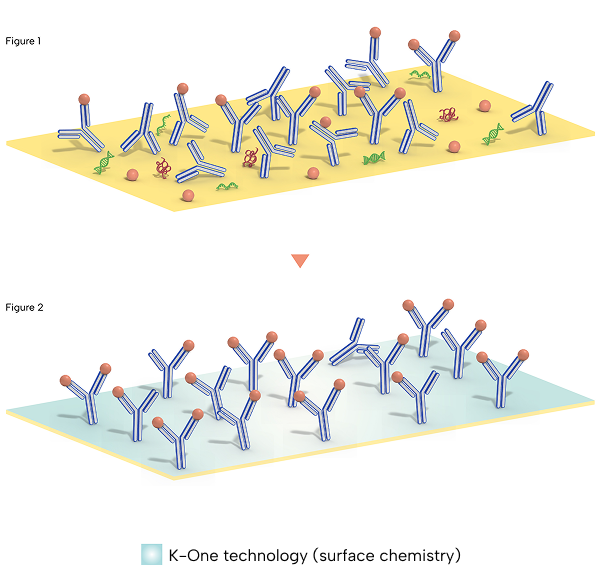
Figure 1 - Ligands bind to the surface of gold nanoparticles or chips in an uncontrolled or even random fashion, resulting in only 20-30% of the ligands being available to interact with their target, while excessive non-specific binding occurs on the surface.
Figure 2 - The K-One technology allows precise control over the ligands' exposure, density, and distribution, while providing a protective shield to the surface.
Exposure: ~90% of the ligands are available to interact with their target, including the most complex structures that are typically challenging to immobilize.
Shield: robust protection of the surface against non-specific binding, reducing background noise and enabling high-quality, reliable data.
Density/distribution: optimized ligand density and spatial distribution minimize avidity effects, mass transport limitations, and recapture, enabling measurements under true affinity-controlled conditions. This also reduces ligand requirements by up to 30x, significantly lowering assay costs.

Join our newsletter to stay up to date on features and releases.
By subscribing you agree to with our Privacy Policy and provide consent to receive updates from our company.

